On Zen Teachers
Zen practitioners should seek teaching everywhere, and will find it if they do: from sutras and texts (dharma), from the community (sangha), from the Zen practice environment (rituals and other forms), and, of course, from those who serve formally as Zen teachers. All of these elements are intended to create a path of support, guidance, and friendship on which to practice and grow.
Role of a Zen Teacher
Within the context of this broader community, there are individuals who sustain the community in various supportive roles, such as board members and practice leaders. We view Zen teachers as fulfilling one of these service roles. Zen teachers share the teachings through dharma talks and dialogues. They also hold certain types of authority, including the authority to meet with other practitioners for spiritual guidance in dokusan, help students work with koans, study the precepts and prepare for Jukai–the ceremony for formally receiving the Zen precepts. Zen teachers also perform liturgical and other ceremonial functions, and may authorize others to teach.
The primary role of the Zen teacher is to offer companionship and guidance to other practitioners through a relationship based on mutual trust and respect. This trusting relationship with a teacher can help to support one’s development of trust in the practice, in the teachings, and ultimately in one's self. The great gift of Zen practice is to trust our lives in each moment. The relationship with a teacher can support the development of this profound trust in our own life and experience.
Qualities of a Zen Teacher
Those who are trusted with a teaching role ideally have had long experience in Zen practice, and have matured in both their spiritual and personal lives sufficiently to earn the trust of those they accompany on the path of awakening and provide them with wise and skillful guidance and support.
The qualities we look for in a Zen teacher include the insight that long practice experience can produce (but does not guarantee). Although insight is necessary, it is not sufficient for fully manifesting a life of humility, wisdom, and compassion. In addition to maintaining a dedicated spiritual practice, a teacher must be committed to continued growth and maturity in all facets of life. This includes ongoing work to reveal and integrate our repressed or hidden parts, which may not become fully visible through our sitting meditation practice alone. It is also important to continue to expand our worldview and capacity to take multiple perspectives.
We also expect a teacher to be able to welcome feedback and admit the inevitable mistakes. And finally, a trusted teacher should know how to maintain healthy boundaries, provide pastoral care when needed, and to understand the dynamics of power in relationships. Perhaps most importantly, Zen teachers should recognize that they are always students and that there is no end to practice or the potential to expand and deepen one’s realization.
Working Out Our Own Salvation
Although teachers can play a valuable role on our journey of awakening, as Siddhartha Gautama, the historical Buddha, is reputed to have said, “Each of us must work out our own salvation (realization) with diligence. Each of us must discover ourselves as that which we are seeking.” Any teacher worthy of one’s attention and respect will want nothing less for and from us. They will simultaneously strive to provide an example of being oneself that is worth imitating and they will not accept mere imitation of that example. Zen is a practice of becoming intimate with and expressing one’s own unique Dharma.
All of this is beautifully summed up by this koan (Book of Serenity Case 52) and its capping verse:
The Case
Caoshan asked elder De, “Buddha’s true Dharma body is like empty sky. It reflects forms just like water. How do you express this principle?”
De said, “It’s like a donkey looking at a well.”
Caoshan said, “You have got the point, but you have said only eighty or ninety percent of it.”
De said, “Master, how would you say it?”
Caoshan said, “It’s just like a well looking at the donkey.”
Capping Verse
When the teacher sees the student,
the student sees the teacher.
For the student to meet the teacher,
he must be the teacher.
Isn’t this the teacher meeting herself?
Isn’t this the student meeting himself?
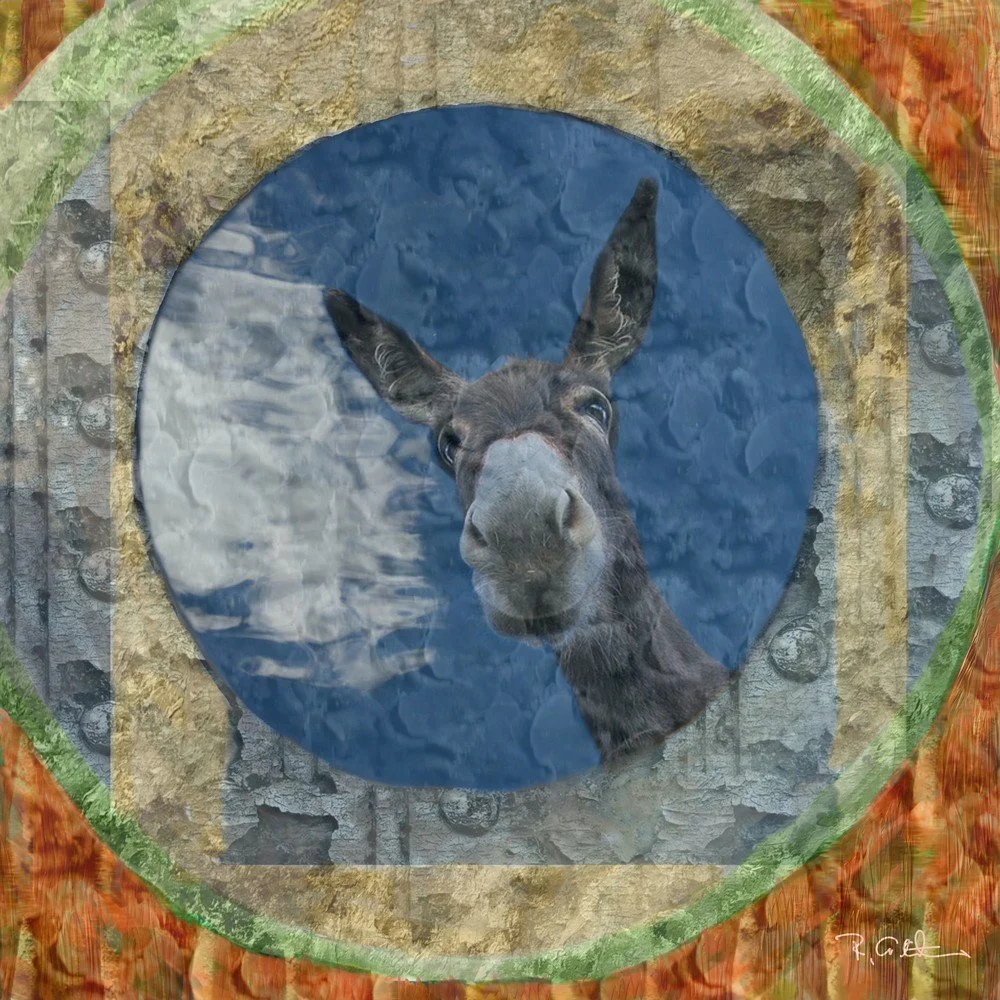
“Who is that one?” by Robert Althouse (used with permission of the artist)