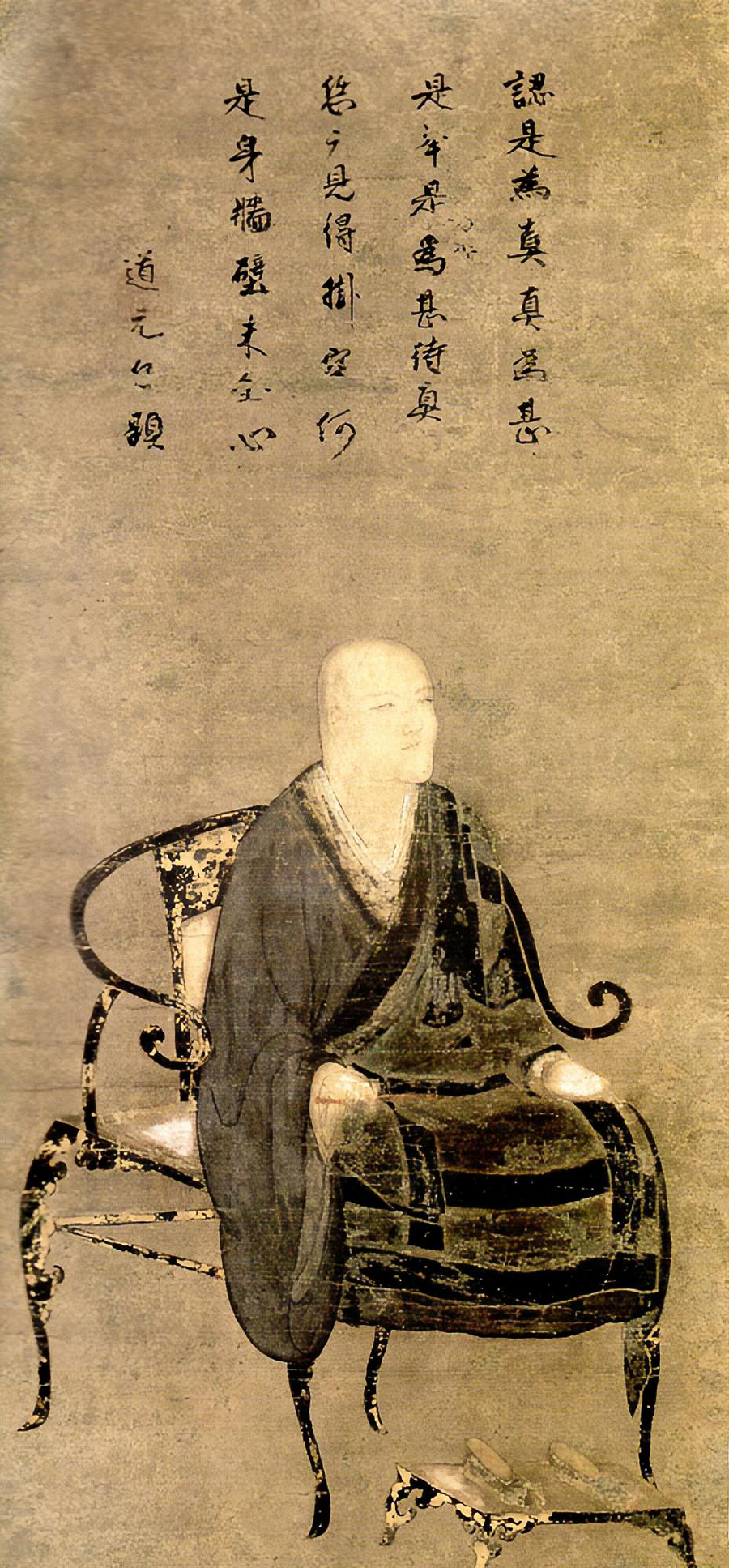
Eihei Dōgen (image from Wikimedia Commons)
Teachings
Zen lore speaks of a “secret transmission beyond words and scriptures.” The “secret” is open, hidden in plain sight, and everything transmits it, including the reams of words and scriptures the Zen tradition has produced. While Zen ultimately is not about ideas, there are many ideas about Zen. Zen practice puts our wonderful capacity for discursive thought into perspective alongside our other wonderful capacities and potential, but Zen is not anti-intellectual. Zen is a whole-person practice. Discursive thought is de-emphasized during meditation, but a Zen life naturally also includes thinking.
Key texts in our Zen stream include the various Mahayana Sutras (especially the Heart Sutra, Diamond Sutra, and Platform Sutra), wisdom poems composed by early teachers, the various koan collections (especially The Gateless Gate, The Blue Cliff Record, The Book of Serenity, and The Transmission of Light), and the writings of Eihei Dōgen, the 13th century founder of Sōtō Zen in Japan. Contemporary introductions to Zen practice we recommend can be found on our reading list.
The Sixteen Bodhisattva Precepts, Zen’s ethical teachings, are the heart of our lived practice. There are several good books on the precepts, yet we especially recommend Nancy Mujo Baker’s Opening to Oneness: A Practical and Philosophical Guide to the Zen Precepts. Baker emphasizes that our greatest, and most spontaneous, capacity for ethical conduct arises from the experience of non-separation. She offers a practical method for working with the precepts that helps us compassionately recognize how we subtly (and sometimes not so subtly) deviate from their literal meaning. She then helps us learn how to reintegrate concealed or unseen parts of ourselves that might lead us to break the precepts unconsciously, or to inappropriately rationalize that we have done so.
Although its light is wide and great, the Moon is reflected in a puddle one inch wide. The whole Moon and the entire sky is reflected in one dew drop on the grass.
— Dōgen Zenji